
Guglielmo Valastro
Policy & Research Executive
The 2027 Germany Federal Budget: Creating the conditions for private investment
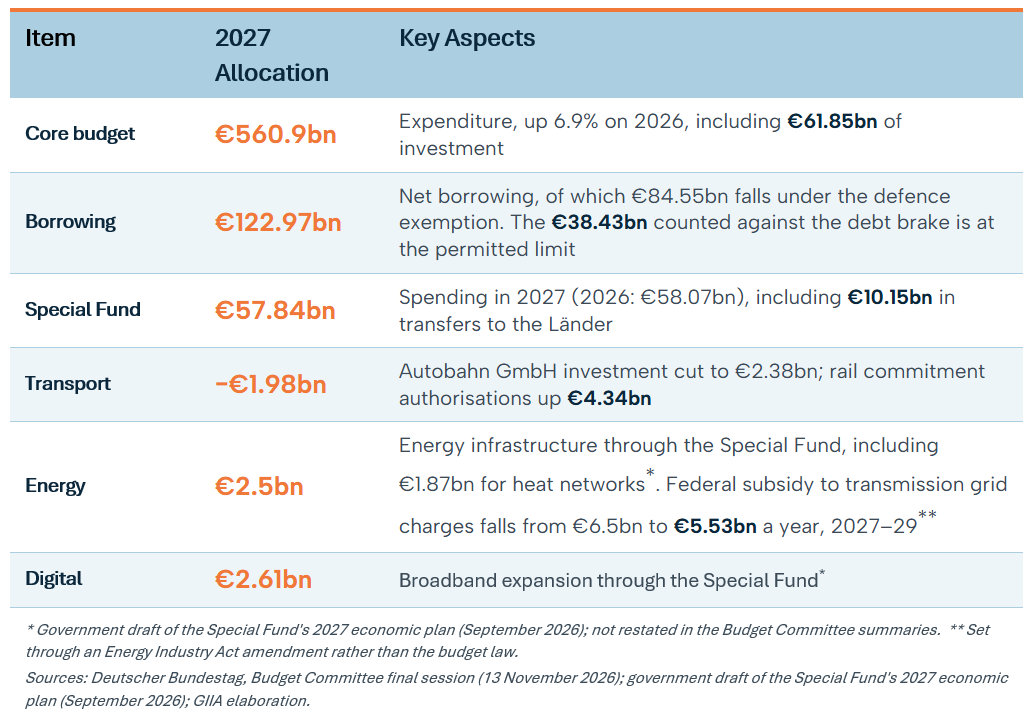
The Bundestag will hold its final vote on the Federal Budget on 27 November 2026, the second budget since the €500bn Special Fund for Infrastructure and Climate Neutrality was established. The figures have already been settled by the Budget Committee on 13 November: €560.9bn of core budget expenditure, including €61.85bn of investment and €57.84 bn of spending through the Special Fund, of which €10.85bn goes to the Länder for infrastructure investment, so the importance comes in how this budget will be implemented and to what degree it can attract new private infrastructure investment.
There are a number of features which stand out for infrastructure investors:
- Special Fund spending in 2027 is relatively flat on 2026 at €58.07bn, it does not bring a step up in public investment in its second year.
- Germany’s fiscal headroom is narrowing. Core budget net borrowing counted against the debt brake, €38.43bn sits at the permitted borrowing limit and a gap of around €25bn is already reported for 2028.
- Transport investment is moving off budget. Autobahn GmbH’s 2027 investment allocation has been cut by ~€2bn to €2.38bn, as the government proposes allowing the company to borrow in its own right.
Taken together, these point to a rising constraint that Germany now faces. Having committed public resources, the question now is how far each euro goes. Investors have noticed the lack of clarity and additionality from this public spending. In our Autumn Infrastructure pulse survey, Germany has dropped from being the second most attractive destination for private investment to fifth, as one investors points out Germany has shown it is willing to spend public money, but its willingness to attract private infrastructure capital is less clear.
Table 1: The 2027 Budget at a Glance
The current policy environment
Germany has built a credible toolkit for using public finance to attract private capital. The Germany Fund (2025) combines ~€30bn of public resources and guarantees with a target of mobilising €130bn in total investment, KfW will be the point of contact here for investors. Investing in infrastructure and renewable energy has been made easier with The Private Investment and Financial Centre Promotion Act (2026) which has eased legal and tax barriers. While there are positive developments in Germany, the scrutiny is still on the Germany Fund, particularly how much of it will reach Germany’s infrastructure.
The budget also highlights a clear gap, how municipal energy networks can attract the large amounts of equity upgrades, resilience and adaptation. KfW estimates that regional energy providers must invest €535bn in distribution networks and grid-connected heat supply by 2045. Its August 2026 programmes, backed by €16.4bn in federal guarantees, addresses the debt side, facilitating up to €41bn of lending over 10 years. However, there is still a €47bn needed to come from new equity, which municipally owned utilities cannot readily raise.
While there are questions surrounding the Germany Fund and access to equity for municipalities, regulated networks remain Germany’s strongest proposition. The Federal Network Agency’s revenue cap system provides a predictable basis for recovering efficient costs and earning regulated returns. The NEST reforms will shorten regulatory periods from five to three years, applying from 2028 for gas and 2029 for electricity distribution. For long term investors, the key test is how capital expenditure and allowed returns are treated over the economic life of the assets.
Where markets cannot yet support investment, Germany has shown it can design workable risk-sharing. The 9,040km hydrogen core network is being built ahead of demand, supported by regulated charges, an amortisation account and a €24bn KfW credit facility, with the federal government bearing 76% of any shortfall remaining in 2055. The Electricity Supply and Security and Capacity Act, approved under the Eu state aid rules in September 2026, applies the same logic to dependable generation capacity.
Germany has also worked on improving its processes, but we have yet to see these improvements translate directly into projects. The Infrastructure Future Act and the Procurement Acceleration Act (both 2026) simplify approval and procurement, but delivery responsibilities still sit with the Lander and municipalities, many of which lack the resources or technical expertise to prepare complex infrastructure investments.
The 2027 Federal Budget has set out how public capital will be allocated in the next year, implementation of that capital will be key in crowding-in private capital. For infrastructure investors six priorities stand out:
1. Provide certainty over transport investment, with a role for private capital
The Autobahn financing bill, which is now before the Transport Committee, would allow the company to borrow from 2027 and receive truck-toll revenue from 2028. Coming Alongside ~€2bn cuts to its 2027 investment allocation, it risks becoming a new borrowing vehicle rather than an opening for private capital. Parliament should adopt it with a defined pipeline of availability-based PPP projects, with private capital entering at project level and the government should confirm which motorway projects remain funded and on what timetable. The €4.34bn increase in rail commitment authorizations should be matched by a multi-year procurement schedule aligned with the Infraplan 2026-2030.
2. Turn Regional Funding into Investable programmes
Transfer to the Länder rise by ~€2bn to €10.15bn. Federal and state authorities should publish project lists and procurement timetables and aggregate smaller municipal investments into larger programmes with standardised contracts at a scale suited for institutional capital. PPPs should be considered for selected transport, municipal and social infrastructure where they allocate risks appropriately and offer value for money.
3. Open a route to equity for municipal energy networks
The KfW and Special Fund spending address debt and public funding but not the €47bn shortfall on equity required. The federal government and the Länder should set out how municipal utilities can bring in long term equity partners through minority stakes, joint venture and project level investment while retaining public control. The pending district-heating package should balance consumer protection with predictable cost recovery for operators.
4. Target digital funding where the market will not reach
The proposed €2.61bn for broadband expansion should focus on areas where commercial deployment is not viable, with transparent procurement coordinated with operators’ own build plans and with the Telecommunication Act amendment now before parliament.
5. Show how public investment will be additional
With Special Fund spending flat for 2027 and borrowing at the debt-brake limit, the government should publish a project level account of how fund expenditure translates into new infrastructure projects distinguishing additional investment from spending transferred out of the core budget. The Ifo Institute estimates that of the €24.3bn borrowed through the fund in 2025, federal investment rose by only €1.3bn.
6. Deliver the pending energy reforms
The Renewable Energy Sources Act reform, the Frid Connection Package and the Offshore Wind Act reform will reset renewable support, grid access, curtailment compensation and the auction design. The Federal Network Agency’s AgNes reform will reallocate electricity network costs. With the federal subsidy to transmission charges falling from €6.5bn to €5.53bn a year from 2027, these reforms will shape both investors revenue risk and the industry’s energy costs. They should priorities revenue stability and clear transitional arrangements for projects already in development.
Taking these steps would provide investors with certainty over how Germany intends to crowd-in private capital to generate growth deliver Germanys infrastructure ambitions.
Conclusion: Federalism and Political Continuity
The budget passed the Budget Committee on votes of the governing collation alone, and Germany’s long term investment programme is unfolding against an increasingly fragmented political landscape. Following state elections in Saxony-Anhalt and Mecklenburg-Westen Pomerania in September 2026, five further state elections are scheduled for 2027, including North Rhine-Westphalia and Lower Saxony, two of Germany’s major industrial regions.
These five states account for approximately €36 billion of the Special Fund’s €100 billion allocation to the Länder and municipalities, with North Rhine-Westphalia alone receiving €21.1 billion. Although funding is established federally, state and municipal authorities retain substantial responsibility for investment priorities and project delivery. More fragmented politics and more complex coalitions at state level could therefore affect the consistency and pace of implementation. The policies underpinning long-term investment are themselves now contested. The AfD has challenged the financing and additionality of the special Fund and, in September 2026, proposed abolishing the Renewable Energy Sources Act.
Germany’s industrial scale, growing investor appetite and new fiscal framework provide the foundations for a sustained infrastructure investment cycle, and its established institutions can provide continuity beyond electoral cycles. The risk for investors lies not with any single party but with a house divided: a long-term programme funded federally but prioritised, permitted and delivered by state and local governments that may increasingly pull in different directions. Germany has built the platforms; what it needs now is the pipeline, and a political system aligned enough to deliver it. Maintaining that coherence across all levels of government, regardless of shifting coalitions, will be essential to investor confidence and to delivering the infrastructure required for the long-term competitiveness of Europe’s industrial powerhouse.
Appendix
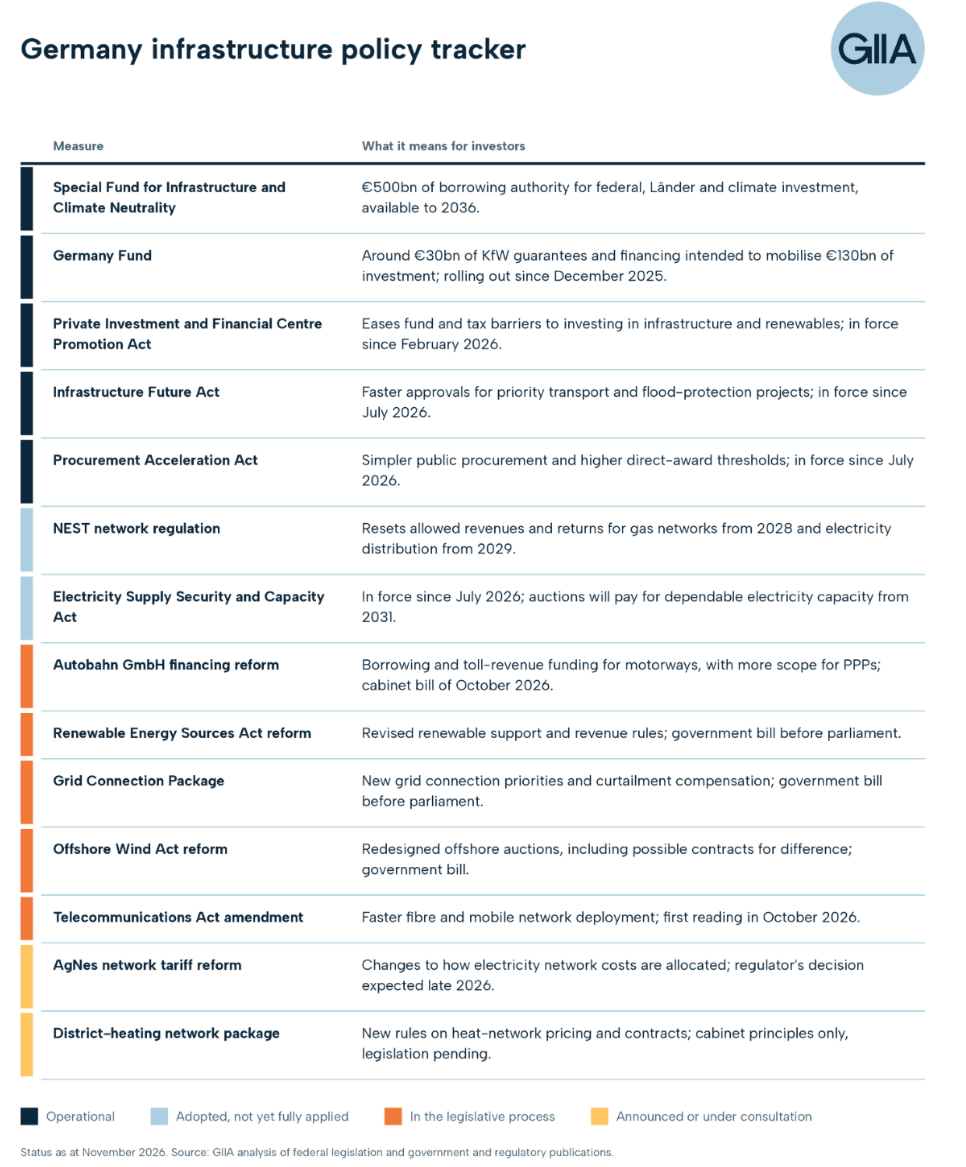
Table A1 – Germany: infrastructure policy at a glance