

Guglielmo Valastro
Policy & Research Executive
Macroeconomic Context and Investment Activity
Executive Summary
Germany presents a defining test of Europe’s ability to translate fiscal capacity into renewed industrial competitiveness. As Europe’s industrial engine, its future growth depends on modernising energy, transport and digital infrastructure after decades of underinvestment. With the strongest public finances among Europe’s largest economies and new frameworks being implemented, Germany is particularly well placed to respond.
However, public investment alone will not meet Germany’s needs, and its advantages are not translating into attractive investment opportunities. Germany overtook its major continental European peers in infrastructure transaction activity in 2025, but its market remains developer-led, with the smallest share of institutional and sovereign investors among them. Connecting this development activity with long-term private capital offers an opportunity to extend the impact of public investment and accelerate industrial renewal.
Realising this potential will require predictable regulation, a credible pipeline of investable projects, effective procurement and appropriate risk allocation, supported by political continuity across Germany’s federal system. In an increasingly competitive global market for infrastructure capital, these conditions will determine whether Germany can translate its financial capacity into sustained investment and stronger economic competitiveness.
GIIA Presence in Germany
Investor sentiment
Germany emerged as Europe’s most attractive infrastructure investment market in GIIA’s Spring 2026 Pulse Survey, ranking second globally behind Canada. Members identified expanded public investment, improved government support and the scale of Germany’s infrastructure requirements as positive developments.
In our latest survey, Germany fell to fifth globally, ranking third in Europe behind Spain and the Nordics. This change highlights the competitive nature of international infrastructure investment. Germany’s scale and financial commitments provide a strong investment proposition, but sustaining investor confidence depends on translating these advantages into credible and investable opportunities. Investors have expressed differing views on Germany’s prospects. While some see growing openness to private capital and scope for public spending to attract institutional investment, others question whether expenditure channelled through existing public institutions could instead limit opportunities for private participation.
Figure 1: Infrastructure investment attractiveness by market (score -5 to +5)
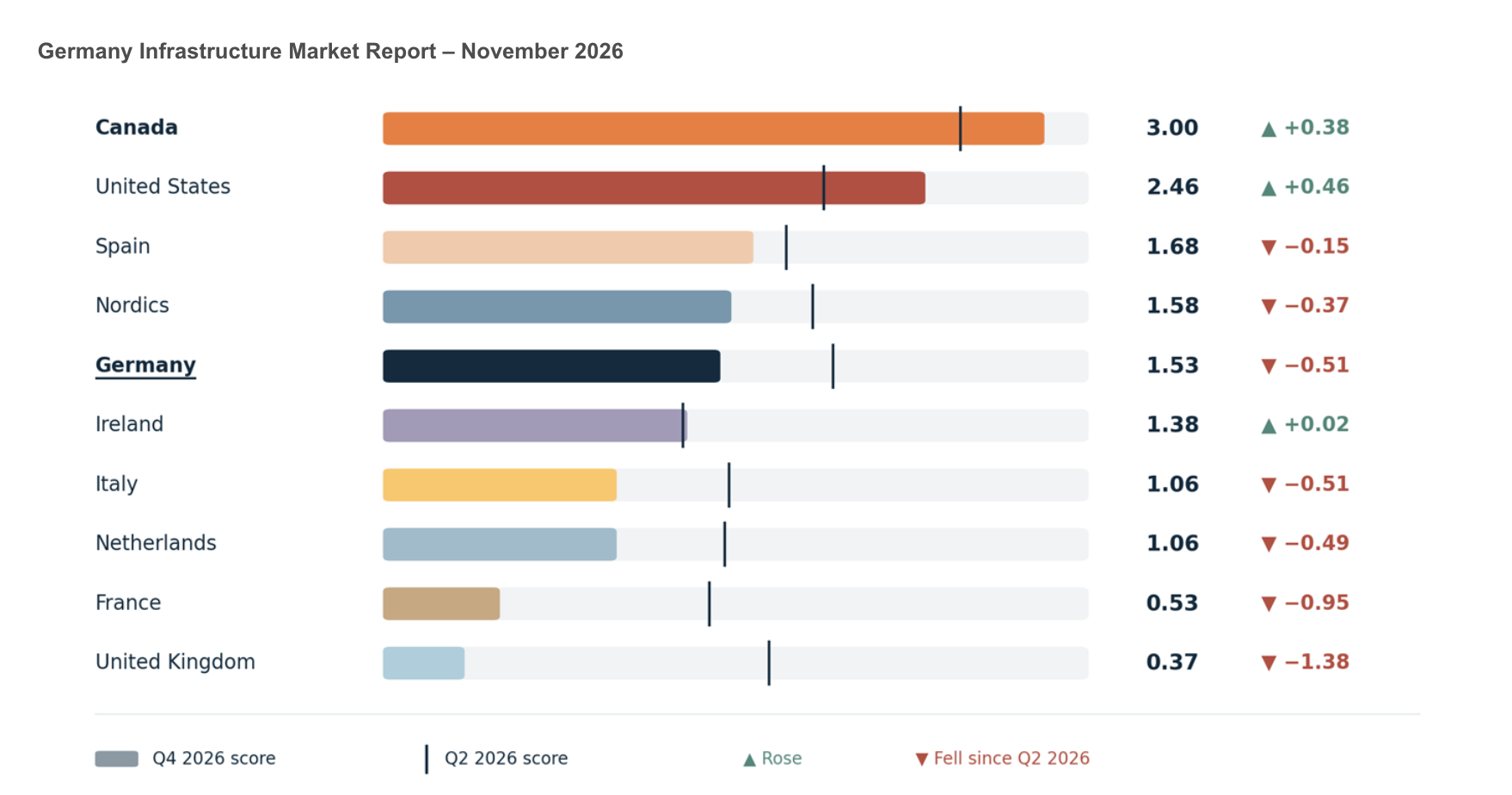
Notes: Infrastructure investment attractiveness scores on a scale from −5 to +5, comparing the Q2 and Q4 2026 survey results. Source: GIIA Infrastructure Pulse Surveys, 2026; GIIA calculations.
Industrial Strength and Infrastructure Needs
Germany is Europe’s largest economy and accounts for ~25% of EU output driven by its industrial structure. Manufacturing represented 19.9% of German gross value added in 2024, compared with an EU average of 15.9%, and smaller shares in Italy (16.6%), Spain (11.9%), and France (10.7%).3 Infrastructure modernisation is central to Germany’s industrial renewal and growth, and it requires competitive electricity costs, reliable grids, efficient freight connections and sufficient digital capacity.
Germany’s recent economic performance contrasts with this industrial strength. While France, Italy and Spain maintained positive growth through much of 2023–2024, Germany experienced a prolonged contraction. The OECD projects a gradual recovery through 2027, although German growth is expected to remain below Spain’s.
Figure 2 – Real GDP growth relative to European peers
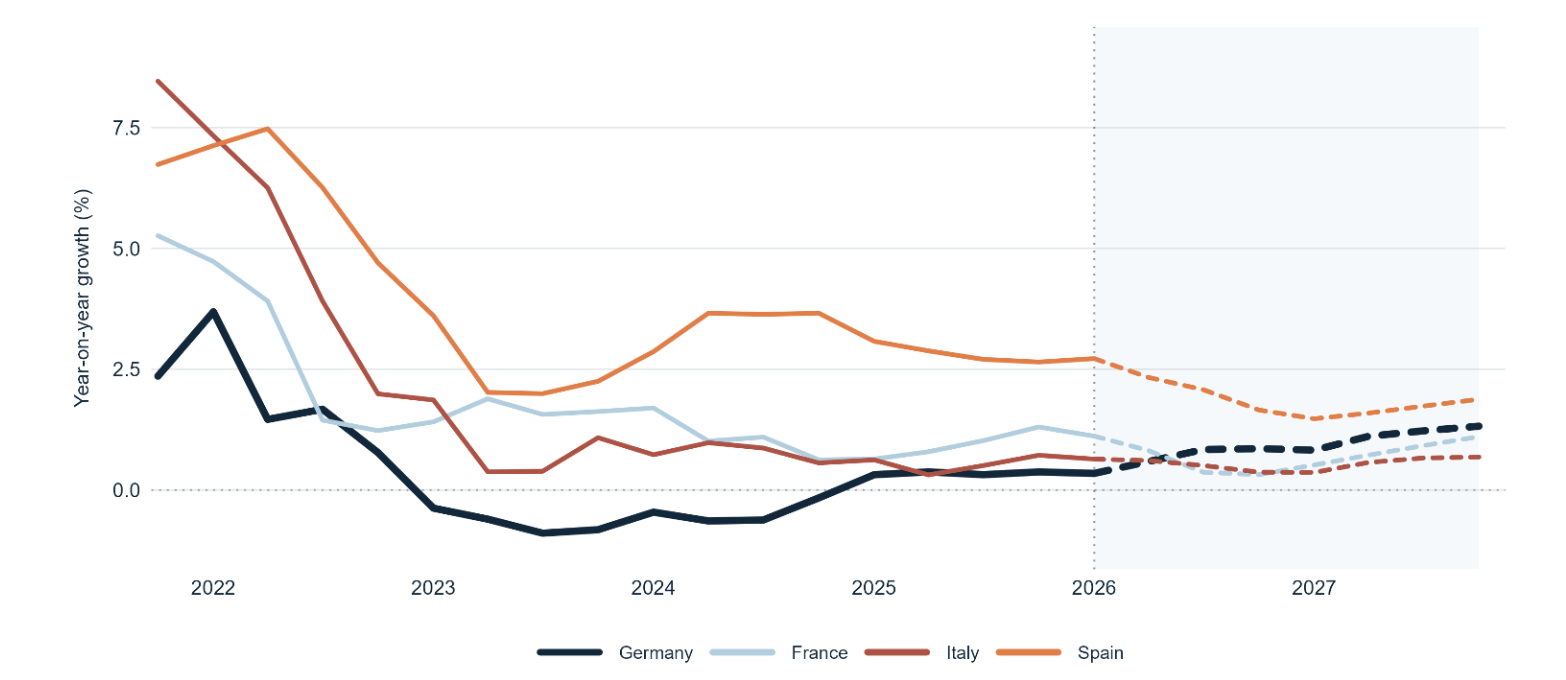
Notes: Quarterly year-on-year real GDP growth. Solid lines represent historical observations; dashed lines represent OECD projections. Source: OECD Economic Outlook No. 119 (June 2026); GIIA calculations and elaboration.
Germany’s infrastructure challenge is a European one. As the continent’s industrial engine, its ability to modernise the networks on which it depends has implications for the competitiveness of the single market as a whole. To restore its industrial competitiveness, Germany needs substantial investment to reduce energy costs, strengthen grid reliability and modernise essential infrastructure. In 2025, electricity prices for German non-household consumers remained 7% above the EU average, and the European Commission identified shortcomings in grid flexibility, digitalisation and the pace of network modernisation. Furthermore, the Federation of German Industries (BDI) estimates that Germany needs around €1.4 trillion of additional public and private investment by 2030 to modernise its infrastructure, support industrial competitiveness and meet its climate goals. At local level, municipalities report a perceived investment backlog of €231.2 billion. Addressing these challenges will require coordinated investment across infrastructure systems, rather than additional expenditure in individual sectors, and unlike many of its major European peers, Germany has the fiscal headroom to respond at scale.
Fiscal Headroom and the Limits of Public Investment
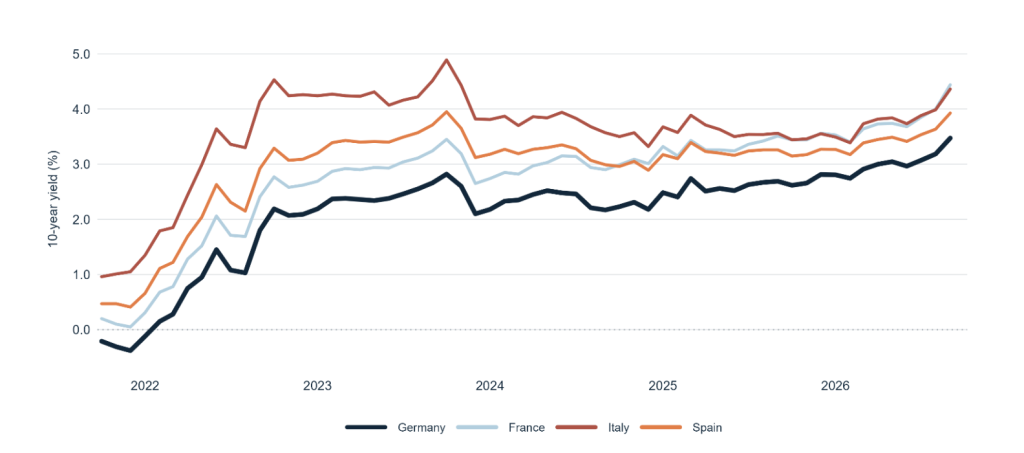
Germany’s strong fiscal position provides an advantage in addressing its infrastructure needs, and few governments in Europe have comparable headroom. At the end of the second quarter of 2026, government debt stood at 63.4% of GDP, considerably below France (119.1%), Italy (139.9%) and Spain (101.4%). Borrowing costs have risen across the euro area as the ECB raised its deposit rate to 2.50% in 2026, taking German ten-year yields to around 3.5%, their highest level since 2011, but still below all three peers. Together, these conditions provide Germany with greater flexibility to support long-term infrastructure investment.
Figure 3: Ten-year sovereign yields relative to European peers
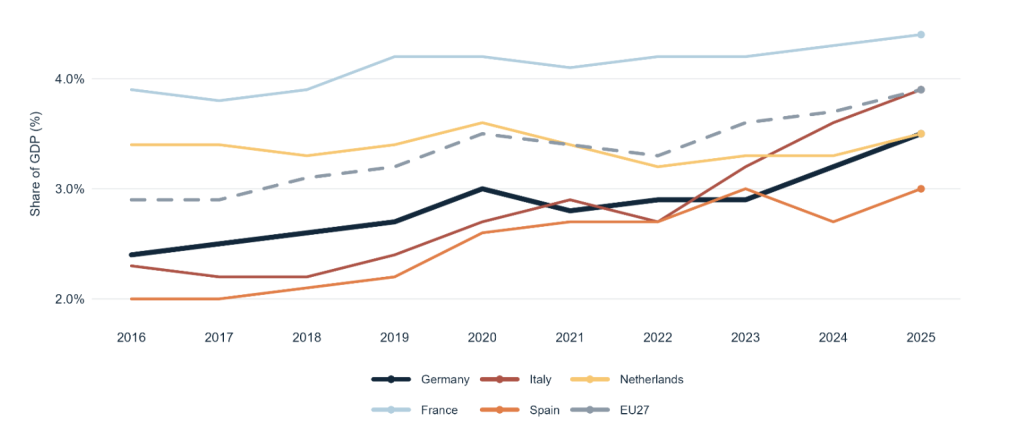
That flexibility has not produced a commensurate investment effort. In 2025, government gross fixed capital formation reached approximately €159 billion, exceeding France’s €132 billion in nominal terms. However, at 3.5% of GDP, German public investment remained below the EU average of 3.9%.
Figure 4: Government gross fixed capital formation relative to European peers.
The €500 billion Special Fund for Infrastructure and Climate Neutrality represents a substantial shift in Germany’s fiscal framework. Established in 2025, it authorises investment commitments through 2036, extending the planning horizon beyond annual budget cycles. Of the total, €300 billion is allocated to federal investment, €100 billion to the Länder and municipalities, and €100 billion to the Climate and Transformation Fund.
The fund provides greater certainty over public investment and can support complementary private capital deployment. However, its additionality remains contested. While the federal government maintains that its fiscal plans meet the legal requirements, the ifo Institute estimates that of the €24.3 billion borrowed through the fund in 2025, federal investment rose by only €1.3 billion, as projects moved from the core budget into the fund. As one investor put it to us, Germany has shown it is willing to spend public money; its willingness to actively attract private infrastructure investors is less clear.
Public investment is necessary, but insufficient. IMK and IW estimate that Germany needs around €600 billion of additional public investment over ten years, excluding defence. The gap can only be closed if Germany uses its fiscal capacity to mobilise complementary private capital. Connecting public financing with investable projects would extend the impact of Germany’s fiscal commitments and support a sustained increase in productive infrastructure investment.
Infrastructure Investment Activity
Germany’s infrastructure market has expanded despite the country’s weak economic performance. In 2025, German transaction numbers rose by 36.3% compared with 2024, making it the most active of the four major European markets.
Figure 5: Completed transactions relative to European peers
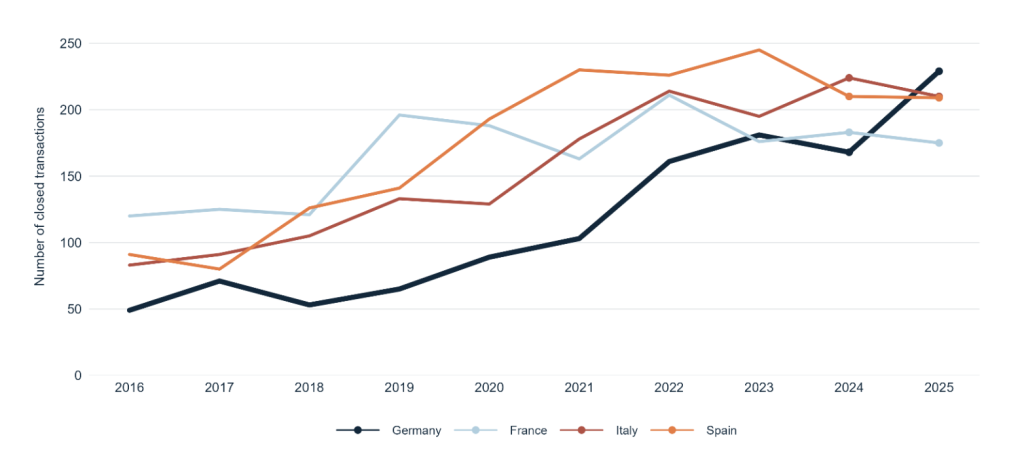
Notes: Annual number of closed infrastructure transactions. Source: Infralogic; GIIA elaboration.
This expansion predates the full implementation of Germany’s latest fiscal and financing reforms, indicating that the market had already developed considerable momentum. The European Commission reports that aggregate private investment in Germany had fallen below its 2015 level by 2025, while infrastructure transaction activity increased almost fivefold over a similar period. While transactions are not a direct measure of capital formation, they suggest that infrastructure has become an increasingly active segment of a weak private investment market.
The energy transition has been a key driver of activity, with renewables accounting for more than half of completed transactions in each of Germany, France, Italy and Spain between January 2025 and October 2026.
Figure 6: Transaction activity by sector
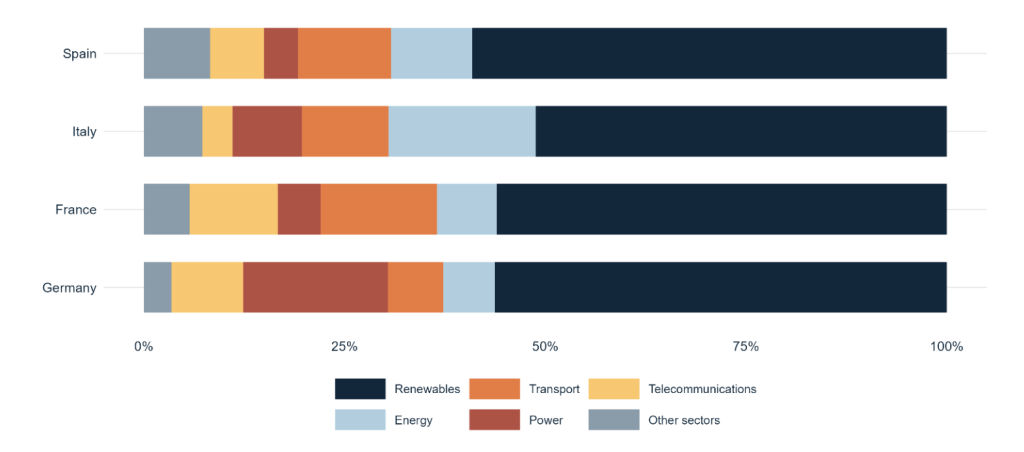
Notes: Sector composition of completed infrastructure transactions from January 2025 to October 2026. Sector shares are calculated from completed transaction counts, not investment value. Source: Infralogic; GIIA calculations and elaboration.
The sector composition reflects the challenge facing Germany and other European markets: advancing decarbonisation while pursuing energy security and electrification. Investment requirements extend beyond renewable generation to electricity networks, storage, flexible capacity and hydrogen infrastructure, whose development must be coordinated to support industrial demand.
Germany also has the highest proportion of greenfield activity across our four key markets: 138 greenfield transactions over 2025 and 2026 to date, or 34.1% of completed deals, ahead of Spain (29.6%), France (28.0%) and Italy (25.7%). This points to a particularly active development market, with significant opportunities for financing new infrastructure rather than simply acquiring existing assets.
Figure 7 – Greenfield investment relative to European peers
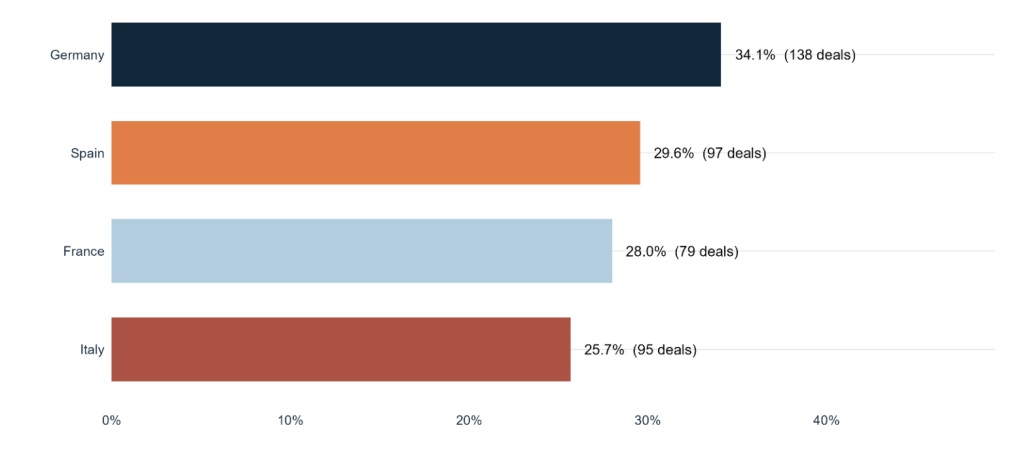
Notes: Greenfield transactions as a share of completed infrastructure transactions, based on deal count. Source: Infralogic; GIIA calculations and elaboration.
While Germany has a better record of infrastructure transaction activity than its neighbours, the composition of participants is underweighted in long-term institutional capital. Developers account for 51.4% of recorded investor classifications, the highest among the four markets. Funds and general partners (GPs) represent 28.7%, in line with peers, and sovereign investors account for just 7.1%, the lowest share of the four countries. We have seen that across Europe, GPs are increasingly willing to take on earlier-stage development risk in pursuit higher returns, however in Germany, the market with the most development activity, they have not moved into it to any greater extent than elsewhere.
Conclusion
Germany presents an unusual combination of promise and friction for infrastructure investors. We have seen that the demand is large and durable, the fiscal advantages substantial and deal activity the highest among the four major European market. The significant share of greenfield transactions also points to a strong development market, with opportunities to finance new infrastructure.
However, the composition of that capital is a sign that the market is not attracting the right kind of long-term capital needed to sustain significant infrastructure investment. The opportunity set is clear but it has not yet reached investors as predictable and well-structured investable projects. Achieving this will require stable regulation, transparent project pipelines, effective procurement and appropriate risk allocation: conditions we will examine in the next paper in this series.
This article was revised ahead of the 2027 German federal budget. Parts of the contents in the original version are available in part II of the insight, available soon.